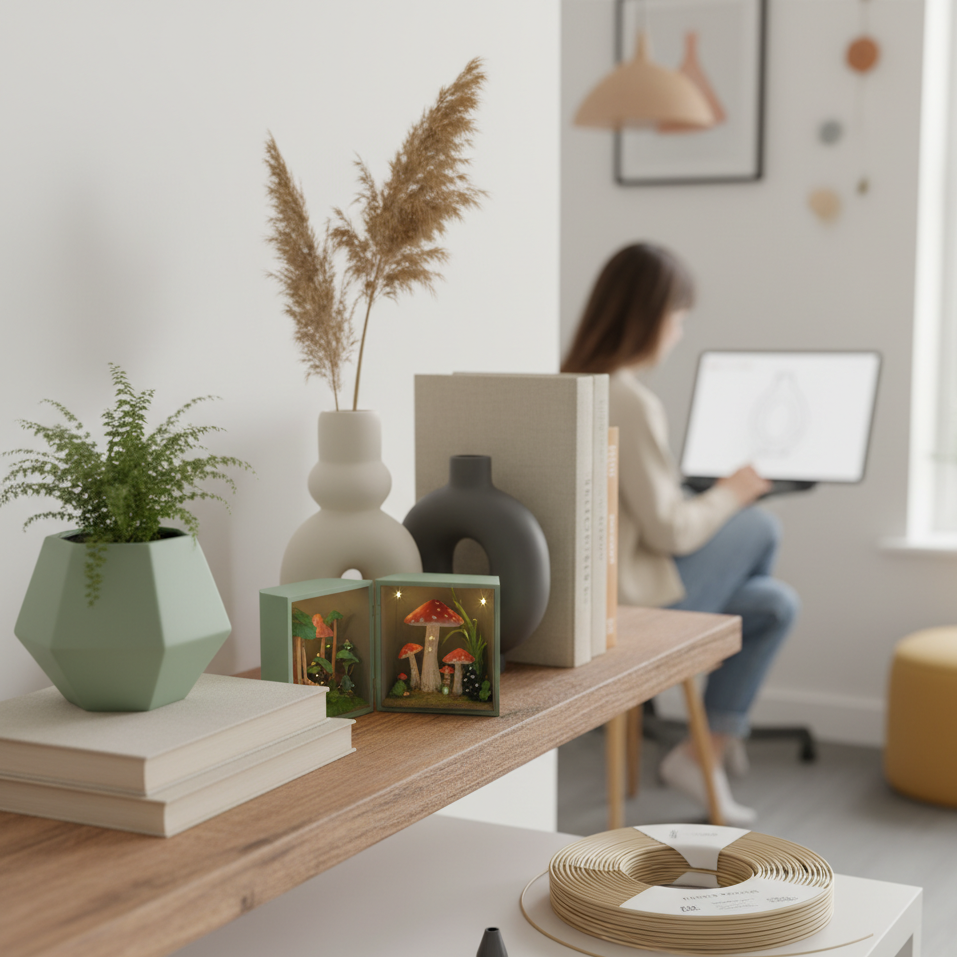


Green Tech: Why 3D Printing is a More Sustainable Choice Than You Think

Why 3D Printing is a More Sustainable Choice Than You Think
When you hear the word "plastic," "eco-friendly" probably isn't the first thing that springs to mind. We get it. In a world drowning in single-use packaging and throwaway culture, it’s easy to see all plastics as the enemy.
But what if we told you that 3D printing, the technology we use to create our unique items at Fiction and Ferns, is actually a surprisingly green process?
It’s true. When you buy a 3D-printed product, you’re often choosing a far more sustainable option than a traditionally mass-produced item. Let's break down why.
We Only Make What's Needed (Goodbye, Waste!)
Think about traditional manufacturing. Often, it's a "subtractive" process. A big block of plastic, wood, or metal is taken, and machines cut, drill, and carve away the material until only the final product is left. All those off-cuts? That's waste.
3D printing is the complete opposite. It’s an "additive" process. We start with nothing and build the item layer by tiny layer, using only the exact amount of material needed. The waste is incredibly minimal.
This is called "on-demand manufacturing." Instead of a giant factory churning out thousands of items that might never sell, we print your order just for you. This means no overproduction and no items ending up in a landfill simply because they didn't sell.
The "Plastic" is Often Plant-Based
This is the big one. Not all plastics are the oil-based villains you're thinking of.
Many of our items are printed with PLA (Polylactic Acid). It's one of the most popular materials for 3D printing, and for good reason: it’s a bioplastic.
In simple terms? It’s made from plants.
PLA is typically derived from renewable resources like fermented corn starch, sugarcane, or tapioca root. This means its production is far less impactful on the planet than traditional plastics, which rely on finite fossil fuels. While it's not "compostable" in your back garden, it is commercially biodegradable, meaning it can be broken down in an industrial facility – a huge step up from plastics that will last for 500+ years.
(Speaking of plants, this technology is perfect for creating our beautiful indoor planters!)
A Tiny Carbon Footprint (Shipping from Home, Not from Afar)
Picture the journey of a typical mass-produced item. It's designed in one country, manufactured in another (often thousands of miles away), packaged, and then shipped across the world on a container ship just to sit in a warehouse. That's a massive carbon footprint before it even gets to you.
Now, picture this: you place an order with us at Fiction and Ferns. We switch on a printer, right here in the UK, and create your item. We pop it in a box and send it directly to you.
That’s it.
By manufacturing items locally and on-demand, we chop that enormous, planet-polluting supply chain down to almost nothing. It’s a massive win for the planet (and cuts down on frustrating wait times!).
Built to Last, Not to Throw Away
On-demand manufacturing also allows for a different level of quality. These aren't flimsy, throwaway bits of plastic. We can create strong, durable, and functional items that are designed to be kept and cherished.
And here's a bonus: 3D printing is a revolutionary tool for repair. Got a broken battery cover or a unique bracket you can't find anywhere? A 3D printer can create a replacement part, saving a whole device from the scrap heap. It’s the ultimate "repair, don't replace" technology.
A Greener Choice You Can Feel Good About
So, while 3D printing isn't a magic bullet that solves all the world's environmental problems, it’s a powerful step in the right direction.
It’s a technology that champions minimal waste, uses renewable, plant-based materials, and cuts out the globe-trotting carbon emissions of mass production.
When you browse our collection of 3D-printed items, you’re not just supporting a small UK business; you’re choosing a product that was made with both you and the planet in mind. And that's a pretty great feeling.