

What is Sustainable Home Decor? - A 2026 Guide to Conscious, Modern Style

What is Sustainable Home Decor?
We all want a home that feels like us, a cosy, stylish sanctuary that tells our story. But in a world of fast-fashion and "next-day" everything, it's easy to feel a little uneasy about the environmental cost of our design choices.
Enter sustainable home decor.
It's a term you've probably seen a lot, but what does it actually mean? For many, it brings to mind reclaimed wood, rough-hewn linen, and a very rustic, earthy vibe. And while that's beautiful, it's only one tiny part of the story.
In 2026, sustainability is just as much about high-tech, modern design as it is about traditional crafts. It’s about making thoughtful, conscious choices that are kinder to the planet.
Think of it as decorating with a conscience. It’s a move away from "fast furniture" and throwaway trends, and a move towards pieces that have a story, a purpose, and a future.
What Makes Homeware "Sustainable"?
In short, sustainable (or "eco-friendly") decor focuses on a few key ideas:
-
Materials: Where do they come from? Are they renewable (like wood), recycled (like glass), or plant-based (like PLA filament)?
-
Production: How was it made? Was it mass-produced in a high-energy factory, or made with a low-waste process?
-
Longevity: Is it built to last? The most sustainable item is one you’ll love and use for years.
-
End-of-Life: What happens to it? Can it be recycled, composted, or will it sit in a landfill?
This might sound complex, but it's really about a few simple shifts in perspective. Here are a few practical ways to start.
1. Re-think "Eco-Friendly Materials"
When we think of eco-friendly materials, our minds go to bamboo, cork, and reclaimed wood. These are fantastic. But innovative, plant-based materials are now a huge part of the solution.
This is where 3D printing comes in. Many people see "plastic" and assume it's bad for the environment. But modern 3D printing doesn't use traditional, fossil-fuel plastics. It uses PLA (Polylactic Acid), a bio-plastic derived from renewable, plant-based sources like corn starch or sugarcane.
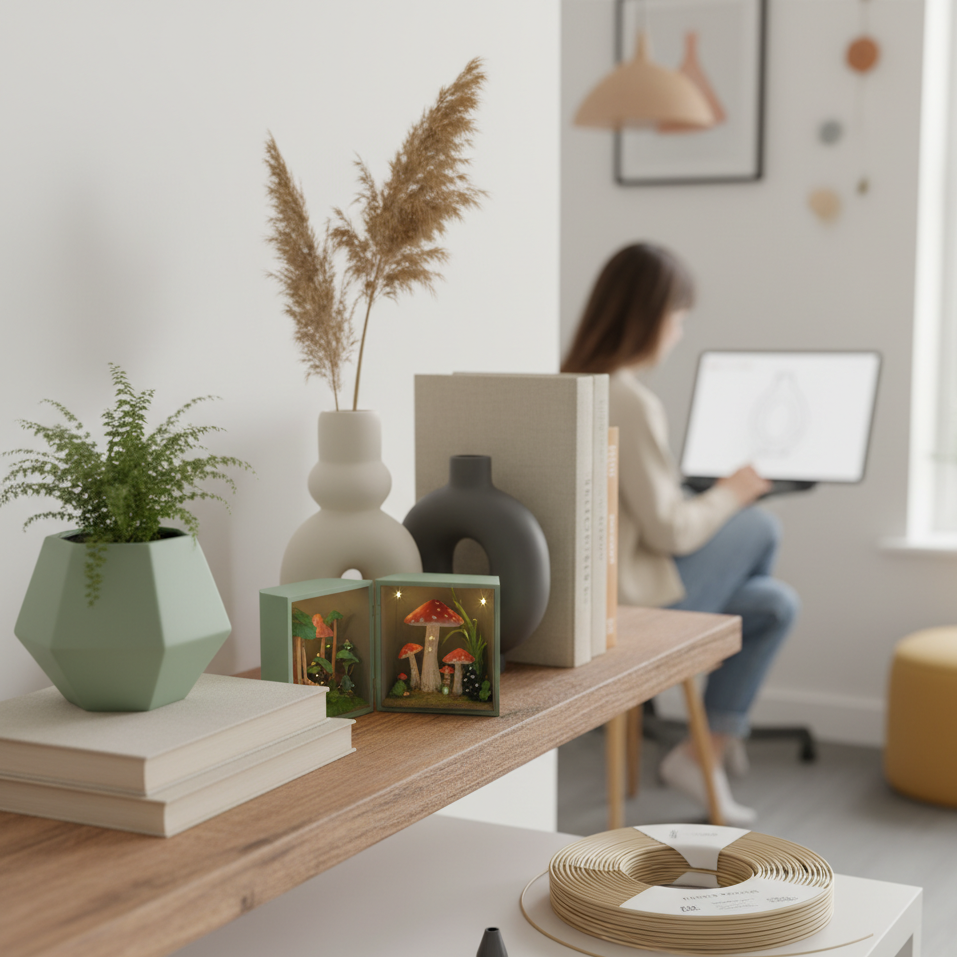
This means you can get intricate, lightweight, and stunningly modern designs—like a minimalist planter that are born from plants, not oil.
2. Choose "Made-to-Order" Over "Mass-Produced"
This is perhaps the biggest hidden waste in the homeware industry. Traditional manufacturing involves "subtractive" methods (cutting away from a bigger block) and mass-producing thousands of items that sit in a warehouse, hoping to be sold. So much of this ends up in landfills.
3D printing is the exact opposite. It's an "additive" process.
-
Virtually Zero Waste: An item is built layer by layer from the ground up. The only material used is the material in the final product. There are no off-cuts or wasted blocks.
-
No Piles of Unsold Stock: At Fiction and Ferns, we don't hold a giant warehouse full of stock. Each piece is printed just for you, when you order it. This "made-to-order" model is the ultimate in sustainable production.
-
Local & Lightweight: Because items are lightweight and printed right here in the UK, the carbon footprint from shipping is dramatically reduced.
3. Favour "Timeless" Over "Trendy"
The most sustainable item is one you'll love for years, not just one season. This is where 3D printing truly shines. It allows for the creation of unique, sculptural homeware that feels like a piece of art.
A quirky glasses holder isn't just a trend; it's a fun, functional piece that brings you joy every day. A beautifully designed book nook isn't something you'll throw away; it's a magical story for your shelf. When you buy something truly unique, you're more likely to treasure it forever.
It's About Progress, Not Perfection
Creating a sustainable home isn't an all-or-nothing race. It's a series of small, conscious choices.
It's realising that "sustainable" can mean a high-tech, 3D printed vase just as much as it can mean a reclaimed wooden bowl. It's about choosing pieces that are made with less waste, from better materials, by a small business that cares.
So, when you're looking for your next piece of home decor, don't just ask if it's beautiful—ask how it was born.
Ready to add a touch of modern, sustainable style to your space? Explore our collection of UK-made 3D printed homeware.